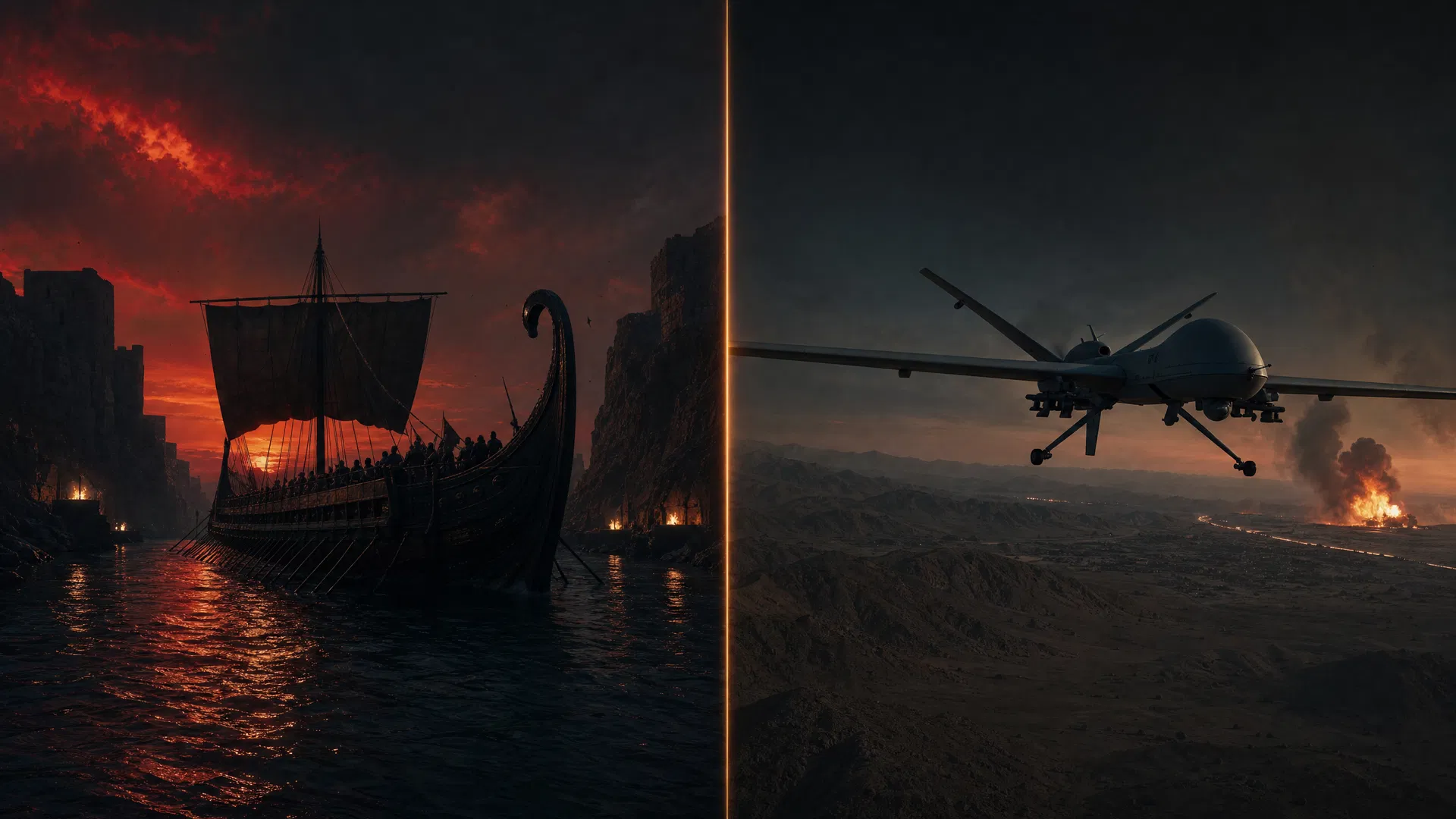
Something is happening in the skies over Ukraine and the Red Sea that should give every American strategist pause. A two thousand dollar drone, assembled from commercial parts, is destroying tanks worth several million. A Shahed built for less than a used car is forcing the United States Navy to fire interceptors costing two million dollars each. Iran and Ukraine are running the same playbook, using cheap technology to disrupt the world's largest militaries, and succeeding far more than anyone expected.
This is not a new problem. It is one of the oldest in the history of organized violence. To think clearly about where it leads, look backward at the three great democracies that shaped the modern world. Athens, Rome, and the United States. Each faced moments when dominance was tested by an opponent using asymmetric means. Athens failed catastrophically. Rome failed often but recovered every time. America is now somewhere in between, and the choice of which model to follow will define the next half century.
The Athenian Warning
In 415 BC, Athens was the unquestioned naval superpower of the Mediterranean. Its triremes were faster, its rowers better trained than any rival's. The Athenian fleet was, in every meaningful sense, the United States Navy of its day.
Then Athens launched the largest expeditionary force in Greek history against Syracuse, five hundred miles from home. The Syracusans, advised by the Spartan general Gylippus, did something very simple. They refused to fight Athens on the open sea where Athenian seamanship mattered. Instead they drew the Athenian fleet into the Great Harbor of Syracuse, a confined body of water where ramming maneuvers were impossible, where long Athenian oars could not get a clean stroke, where heavy infantry fighting from decks mattered more than skilled rowing. They built broader, sturdier ships. They blocked the harbor with a chain of vessels. They turned a naval contest into a brawl in a swimming pool.
The greatest navy in the world was neutralized not because the Syracusans built a better fleet, but because they refused to let Athens use the fleet it had. The expedition ended with the Athenian army and navy destroyed almost to the last man. Athens never recovered.
That is the cautionary half of the story. A great power's signature strength becomes a liability the moment an adversary forces it to fight where that strength does not matter.
The Roman Answer
Rome lost battles constantly. Cannae cost Rome fifty thousand men in a single afternoon. Carrhae destroyed seven legions to Parthian horse archers. Teutoburg swallowed three more in a German forest. What separated Rome from every other ancient power was not that it won. It was that losing did not break it.
After Cannae, the Senate refused to negotiate with Hannibal. It raised new legions, adopted a long delaying strategy under Fabius Maximus, and accepted years of public humiliation. Within fifteen years Hannibal was driven from Italy and defeated at Zama. After Carrhae, Rome studied what went wrong, integrated cavalry into its armies, and campaigned effectively against the Parthians for the next three centuries. After Teutoburg, Rome fortified the Rhine and accepted the loss. The empire kept consolidating for another hundred and fifty years.
The Roman pattern was consistent. Absorb the loss. Refuse to negotiate from weakness. Adapt institutionally. Take as long as needed.
What America Must Learn
Iran spent fifty years building the capability that is now disrupting global commerce and threatening American forces in the region. Fifty years of proxy networks, missile development, drone manufacturing, and ideological cultivation. No serious person should expect that capability to be dismantled in three or four weeks of strikes, or in a single administration, or by any clever technological fix.
This is the Roman lesson America most needs right now. The work ahead will take years, possibly decades. It will require sustained investment in directed energy weapons, electronic warfare, counter-drone systems, and the unglamorous industrial base that produces chips, motors, and batteries. It will require pressure on Iran's proxies, its supply chains, its sponsors, and its economy across multiple election cycles, under presidents of both parties, through political weather that will sometimes make patience deeply unpopular.
The reason it must be done is that the alternative is unacceptable. A regime governed by religious zealots who genuinely believe that destroying the world brings them to a better one cannot be allowed to combine that worldview with nuclear weapons and a maturing drone and missile arsenal. This is an existential category of threat, and existential threats are not solved by quarterly metrics.
Athens lost its century in a harbor in Sicily, gambling everything on a war it did not need to fight on terms it did not control. Rome won its centuries by refusing to let any single defeat become permanent. America stands now where both once stood. History does not tell us which path we will choose. It tells us clearly what the consequences of each choice will be.