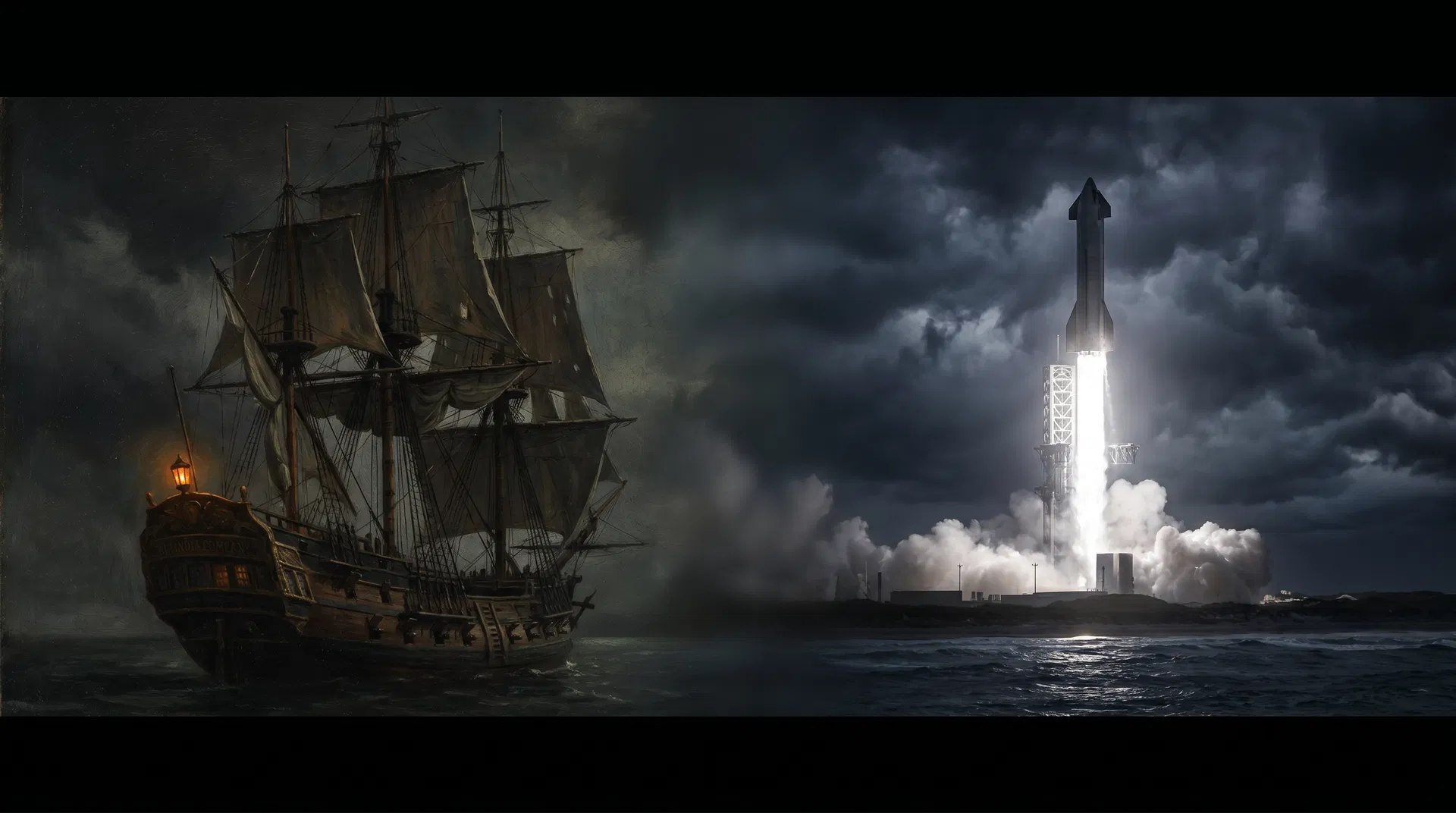
On the last day of 1600, Queen Elizabeth I sat down and signed a piece of paper that handed roughly two hundred London merchants exclusive English trading rights to a swath of the planet stretching from the Cape of Good Hope to Cape Horn. They called themselves the Governor and Company of Merchants of London Trading into the East Indies. History gave them a shorter name: the British East India Company.
Nobody buying into the early voyages had any idea what they were actually funding. They thought they were backing a spice trading outfit. What they were really backing was the platform that would crack open the world.
Pause for a moment and look at what that little syndicate of London merchants actually pulled off between 1600 and its dissolution in 1874.
They built the first permanent English trading post in India at Surat in 1612. Then Madras in 1639. Then Bombay by 1668. Then Calcutta in 1690. Each of those posts grew into a city. By the mid-1700s the Company was responsible for roughly half of all global trade. Half. They flooded ordinary British homes with cotton, tea, porcelain, indigo, and silk at prices and volumes that historians now credit with kicking off consumer culture itself. They paid dividends as high as thirty percent. They built a private army of about 260,000 soldiers by 1800, more than twice the size of the standing British Army at the time. They beat the French at Plassey in 1757, and again at Wandiwash in 1760. By 1765 they had won the right to collect tax revenue across Bengal, Bihar, and Orissa. By the early 1800s they were governing hundreds of millions of people from a London office of 159 staff. One hundred and fifty-nine. From a single building in London. Running a chunk of the world.
When the Company was finally wound down, The Times of London wrote that it had accomplished a work no other trading company in the history of the human race had ever attempted, and that none was likely to attempt again.
That obituary has held up for one hundred and fifty years. It is about to be tested.
The East India Company was the first private entity ever to combine, under one corporate roof, control of the means of transport, control of the communication channels along its routes, and control of the operational presence at the destination. If you wanted to play in the new world economy of that age, you played through them. They were not a company. They were a civilizational operating system.
We are about to watch the second one go public.
The Headline Number Is the Least Interesting Thing About This Deal
The financial press is fixated on the valuation. One and three-quarter trillion dollars. Largest IPO in history. Seventy-five billion in fresh capital. Thirty percent of shares carved out for retail, which is unheard of. Yes, all of that is true, and yes, it is going to break records. But the headline number is the least interesting thing about this deal.
Here is what is actually happening. Elon Musk is taking everything he has built across multiple companies, multiple disciplines, and multiple industries, and channeling it into a single corporate envelope that is being aimed squarely at the next frontier. Not a market. A frontier. The British East India Company opened the seas. SpaceX is opening the stars. And the public is being invited onto the cap table for the first time.
Most people still describe SpaceX as a rocket company. That is roughly as accurate as describing the East India Company as a shipping firm. The rockets are the means. The business is what the rockets unlock.
Let me walk through what actually sits inside the SpaceX corporate envelope right now, and what each piece becomes when you stop thinking about it as a terrestrial product and start thinking about it as infrastructure for a multiplanetary civilization.
The Stack
Starship and Falcon are the modern East Indiamen. They are how you move mass and people across the new ocean. The cost curve SpaceX has driven on launch is the single most important enabling condition for everything that follows. Without cheap, reusable, high-cadence access to orbit, none of the rest of this works. With it, almost every other constraint becomes solvable.
Starlink is sold today as broadband for boats, RVs, and rural homes. That is the cover story. The actual asset is a deployed, working, revenue-generating mesh communication network in low Earth orbit, with direct-to-cell rolling out, and with no terrestrial competitor at remotely comparable scale. Starlink in its current form is internet for Earth. Starlink in its mature form is the carrier signal between worlds. The same way the telecoms built copper, then fiber, then cellular here at home, Starlink will be the communication backbone connecting Earth to every outpost we ever build beyond it. That is not a stretch. That is the obvious next step.
xAI, which SpaceX absorbed in February at a combined valuation of one and a quarter trillion dollars, brings two assets that matter. The first is a frontier AI lab and the Colossus training supercomputer. The second is X, the platform formerly known as Twitter. SpaceX has already filed with the FCC for authority to launch a constellation of up to one million satellites designed to operate as orbital data centers: solar powered, optically linked, purpose built to run AI workloads in space, where energy and cooling stop being constraints in the way they are on Earth. Read that sentence again. The thesis is that within a few years, the cheapest place in the solar system to generate AI compute will be orbit. If that is even directionally correct, the entire AI industry gets reordered.
X, the platform, is something almost nobody has correctly priced. Stop thinking of X as a media company. Start thinking of it as a globally distributed, real-time, human-powered reporting network with hundreds of millions of contributors. As exploration moves outward, X becomes the natural reporting layer for that exploration. It is not journalists telling the story of space. It is the people in space, and the people watching from Earth, telling each other directly. That is a brand new kind of news organization. SpaceX owns it.
Cursor, the agentic coding company, signed a deal with SpaceX in April. The structure is unusual. SpaceX has the option to acquire Cursor outright for sixty billion dollars later this year, or to pay ten billion just for what they are already building together. Either way, the strategic outcome is the same. Cursor combined with xAI compute and Colossus-scale training is a serious bid to own the future of software development itself. Software is how you operate everything from a Starlink terminal to a Mars habitat to a fleet of orbital data centers. Whoever owns the dominant agentic coding stack owns a meaningful slice of how every other company in this ecosystem ships product.
Tesla is still a separately traded company today. It will not be for long. Wall Street analysts are openly speculating that some form of combination between SpaceX and Tesla over the next twelve to eighteen months is increasingly plausible, and the strategic logic is obvious. When humanity goes to Mars, we are not sending enough people to build a city. We are sending robots. Tesla has Optimus. Tesla has the manufacturing base. Tesla has battery and energy storage at scale through Megapack, which xAI is already deploying inside its data centers. Folding Tesla into SpaceX is not financial engineering. It is the missing piece of a fully integrated off-planet construction and operations company.
And while we are on the subject of robots, there are other tuck-in acquisitions that fit this picture beautifully. Bedrock Robotics, founded by Waymo veterans, is automating excavators and heavy construction equipment with retrofit autonomy kits. Their commercial pitch on Earth is solving the construction labor shortage. Their actual capability is exactly what you need to clear ground and build infrastructure on Mars or the Moon. You really want that owned inside the platform rather than rented from somebody else. There will be more of these.
Why the East India Analogy Holds
Strip away four hundred and twenty-six years and the structural picture is identical.
The Company controlled the ships, the ports, the communication links between London and Asia, the commercial presence on the ground, and eventually the administrative and military apparatus that operated at the destination.
SpaceX is converging on the same configuration for a frontier that is, by any reasonable measure, infinitely larger.
- Transport: Falcon, Starship, and a launch cadence no competitor can touch.
- Communication: Starlink on Earth, in orbit, and eventually between celestial bodies.
- Compute and intelligence: xAI, Colossus, and a planned orbital data center constellation that could move where AI actually runs.
- Information layer: X as the real-time reporting and conversation network for the entire civilization participating in this expansion.
- Software: Cursor as the development environment for everything built on top of the stack.
- Operations at the destination: Tesla robotics, almost certainly, before this decade is out. Plus Bedrock and whoever else gets pulled in along the way.
No prior IPO in the history of finance has ever offered the public entry into a portfolio of capabilities this complete, aimed at a market this large, controlled by a single operating entity. Not Aramco. Not Alibaba. Not even Standard Oil at its peak controlled this many adjacent layers. We are in genuinely new territory.
The Bear Case, Honestly Stated
Now, before anyone accuses me of cheerleading, let me put the risks on the table because they are real.
SpaceX has never published a public financial statement. The combined entity reportedly posted a net loss of about five billion dollars in 2025, with Starlink profitability getting offset by losses at xAI and X. At a one and three-quarter trillion dollar valuation, the multiple is roughly 125 times trailing revenue. That is higher than Tesla. Higher than Palantir. Historically the kind of multiple that compresses, sometimes painfully. PitchBook has pegged a defensible range closer to one and one-tenth to one and seven-tenths trillion, which suggests the high end of the expected pricing leaves precious little margin for execution slippage. Orbital data centers are still a thesis, not a product. Starship is a working program but not yet a routine commercial service. The path from here to the vision requires a great deal to go right.
These are real risks. They are also, structurally, the same kind of risks the East India Company faced for its first several decades, when most of its early voyages lost money and several lost their ships entirely. The investors who held through that period funded what became the most consequential commercial entity of its era. Their grandchildren did very, very well.
The bear case on SpaceX is a bear case on the next two or three years. The bull case is a bull case on the next century. Those are not the same conversation, and pretending they are is the single biggest analytical mistake the financial press is going to make over the next sixty days.
The Bottom Line
The financial press is going to spend the next two months obsessing over whether SpaceX prices at one and a half trillion or one and three-quarters or breaks two. They will debate the multiple. They will argue about Starlink's growth rate. They will write a hundred articles about whether thirty percent retail allocation is a good idea or a bad one. And while they are doing all of that, they are going to miss the actual story.
The actual story is that for the first time, ordinary investors are being offered shares in the platform that will connect Earth to everything beyond it. The transport layer. The communication layer. The compute layer. The information layer. The software layer. And almost certainly, soon enough, the robotics and physical operations layer. All owned by one company. All integrated by one operating philosophy. All aimed at the same horizon.
If Musk executes even half of what is currently telegraphed, this is not the largest IPO of all time. It is the most consequential company of the modern era going public, on the threshold of the largest commercial frontier in human history.
The East India Company opened the world. It ran for two hundred and seventy-four years. Generations of London families passed those shares down. Fortunes were built on a single decision made by a great-great-grandfather to commit a few pounds to a speculative trading venture in 1600.
SpaceX is opening the stars. The chance to be on the cap table of the second one does not come around often. By my count, it has come around exactly once in four hundred and twenty-six years.
So let me make this simple: be on the cap table.